
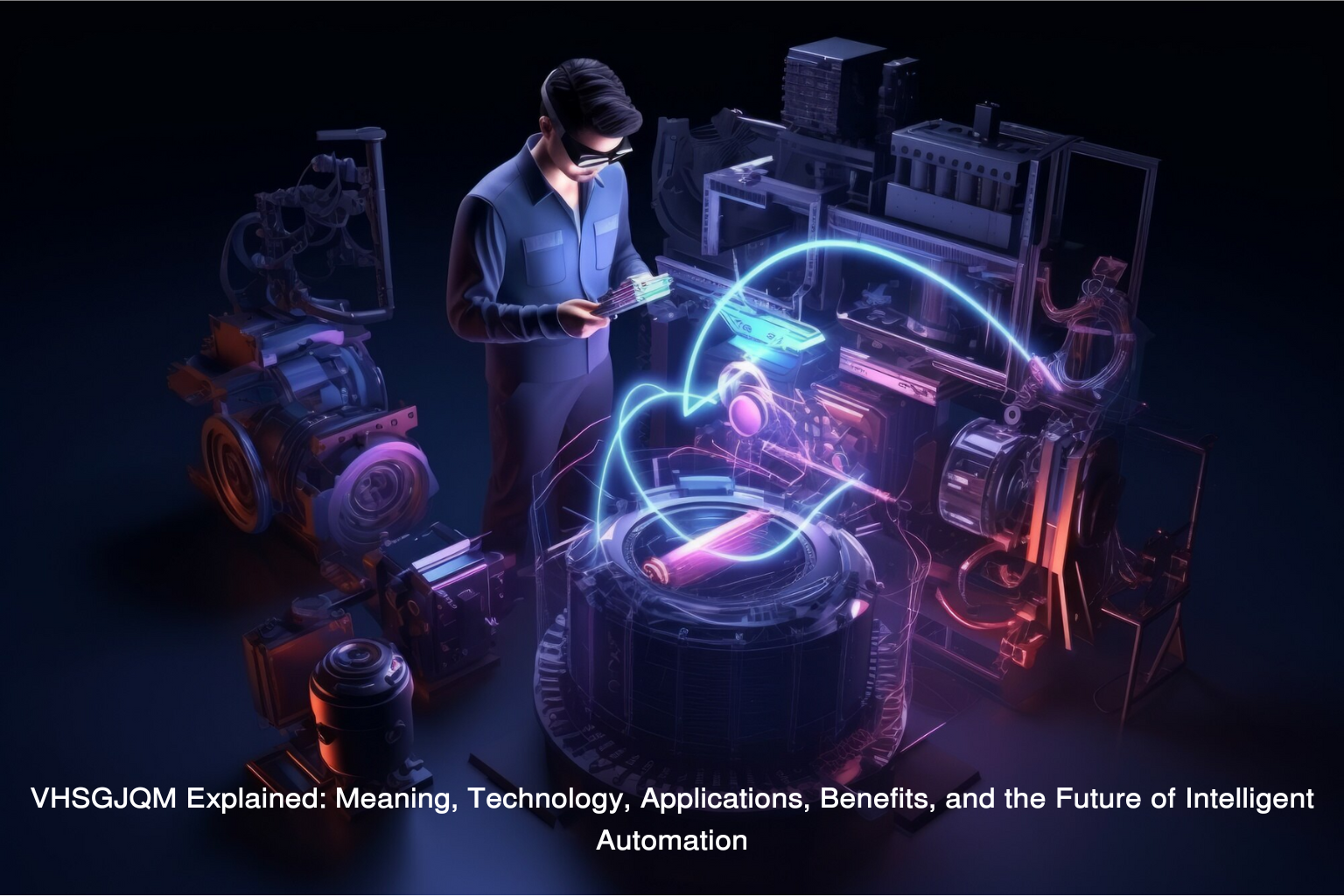
Artificial intelligence continues to evolve at an unprecedented pace, reshaping industries and redefining what machines can accomplish. Among the most intriguing emerging concepts is VHSGJQM — a term gaining traction in tech conversations for its promise to integrate AI, automation, quantum‑inspired computing, and ethical reasoning into a powerful hybrid framework.
This comprehensive guide explains what VHSGJQM really is, how it works, why it matters, its real‑world applications, benefits, challenges, and the future impact of this transformative technology.
What Is VHSGJQM?
VHSGJQM Meaning and Full Form
VHSGJQM stands for Virtual Hybrid System for Generalized Quantum Modeling. In simple terms, it’s a conceptual framework that blends multiple advanced technologies — artificial intelligence (AI), machine learning (ML), quantum computing principles, and semantic reasoning — into one adaptive system.
The name may look complex, but its purpose is straightforward: create a next‑generation intelligent platform that learns dynamically, reasons with context, and operates with transparency and ethical oversight.
Is VHSGJQM a Real or Conceptual Technology?
As of 2025, VHSGJQM remains largely conceptual — a visionary architecture that researchers and tech thought leaders use to describe future directions for AI and automation systems. While no commercial product currently carries the VHSGJQM label, several emerging technologies mirror its principles:
- Neural‑symbolic AI
- Quantum neural networks
- Cognitive computing models
- Hybrid AI architectures
These real‑world systems demonstrate components similar to VHSGJQM, making it a plausible and realistic model for next‑generation AI systems.
Why VHSGJQM Is Gaining Attention in 2025
Interest in VHSGJQM stems from growing limitations of traditional AI:
- Narrow task focus
- Inability to adapt to context
- Lack of ethical reasoning
- Limited explainability
By integrating data fusion, quantum‑inspired processing, semantic understanding, and ethical governance, VHSGJQM promises not just intelligent automation but context‑aware, transparent, self‑evolving systems.
The Origin and Evolution of VHSGJQM
When and How the VHSGJQM Concept Emerged
The roots of VHSGJQM trace back to early explorations in hybrid AI, where symbolic reasoning met statistical learning. While the acronym itself may be fictional, its underlying philosophy reflects trends seen in:
- Neural‑symbolic integration research (late 2010s)
- Quantum machine learning proposals (2020 onward)
- Cognitive computing designs bridging logic and learning
Around 2022, thought leaders began referencing integrated AI‑automation frameworks resembling VHSGJQM, particularly in academic papers and innovation strategy discussions.
Inspiration from AI, Quantum Computing, and Automation
VHSGJQM draws inspiration from three major technological streams:
- AI & Machine Learning — for pattern recognition, prediction, and adaptive learning.
- Quantum Computing Principles — for parallelism and optimization capacity.
- Workflow Automation — to streamline processes across enterprises.
By combining these, VHSGJQM represents a systems‑level leap beyond narrow AI.
How VHSGJQM Evolved Into a Hybrid Intelligence Framework
Early AI systems focused on narrow tasks (e.g., image classification, NLP). Over time, innovators realized that:
- Real systems must handle multi‑modal data
- Reasoning requires context understanding
- Trustworthy systems need ethical safeguards
VHSGJQM embodies this evolution by introducing layers like semantic context processing and an ethical logic unit, making it more than a model — it’s a blueprint for future AI governance‑ready systems.
How VHSGJQM Works
Overview of the VHSGJQM Operational Model
At its core, VHSGJQM integrates multiple layers of computation:
- Data aggregation and normalization
- Parallel processing with quantum‑like optimization
- Learning and inference via neural and reasoning engines
- Ethical oversight and contextual interpretation
- Continuous self‑feedback loops for improvement
This hybrid structure enables systems to not only compute intelligence but also reason intelligently.
Role of Artificial Intelligence and Machine Learning
AI and ML provide the backbone for pattern recognition and predictive capabilities within VHSGJQM. Unlike traditional ML workflows that rely heavily on labeled data, VHSGJQM’s self‑learning mechanisms allow:
- Rapid adaptation to new environments
- Contextual reasoning
- Reduced dependence on human supervision
For example, instead of training models solely on historical user data, VHSGJQM can learn from real‑time feedback and adjust dynamically.
Quantum‑Inspired Computing and Parallel Processing
Although true quantum computers are still emerging, VHSGJQM proposes quantum emulation layers that mimic aspects of quantum behavior:
- Parallel computation
- Entanglement‑style optimization
- Faster search and inference
This means systems can handle complex optimization problems with greater efficiency than classic AI architectures, even without actual quantum hardware.
Real‑Time Analytics and Self‑Learning Feedback Loops
A critical feature of VHSGJQM is its ability to embed learning within rollout cycles. After each decision or outcome, systems can:
- Analyze real‑world responses
- Recalibrate internal logic
- Improve subsequent predictions
This continuous feedback loop resembles human cognitive learning more than static machine training.
Core Architecture of VHSGJQM
Data Fusion and Intelligent Data Management Layer
This layer collects and integrates multi‑source data:
- Images
- Text
- IoT sensor input
- Audio
- Structured databases
- Unstructured streams
By normalizing and fusing all inputs, VHSGJQM can reason holistically rather than in silos.
Quantum Emulation and Optimization Engine
Instead of relying on pure classical compute, VHSGJQM can emulate quantum‑like processes to:
- Solve complex optimization problems
- Perform parallel evaluations
- Reduce computation latency
This makes it particularly powerful for tasks like:
- Traffic optimization
- Financial forecasting
- Resource allocation
Neural Reasoning and Decision‑Making Engine
Unlike traditional neural networks that only classify or predict, this engine supports reasoned decision making. It blends deep learning with logical inference, enabling:
- Better contextual understanding
- Adaptive strategies
- Long‑term planning
Semantic Context and Intent Understanding
Semantic processing allows VHSGJQM to interpret meaning beyond data. Instead of just processing raw numbers or text, it can:
- Extract sentiment and intent
- Understand nuance and context
- Predict human motivation
This capability drastically improves interactions, especially in systems like chatbots or autonomous agents.
Ethical Logic and Explainable AI Unit
One of VHSGJQM’s most important innovations is embedding ethics at the core:
- Bias mitigation
- Transparent decision trails
- Accountability logging
Compliance with global standards (e.g., OECD AI Principles, UNESCO guidelines) becomes easier when accountability is built‑in.
Continuous Self‑Optimization and Learning System
After every cycle, the system:
- Evaluates outcomes
- Updates internal models
- Refines logic rules
This means the system continues to evolve — not simply react — allowing long‑term improvement across domains.
Key Features and Characteristics of VHSGJQM
Hybrid AI and Cross‑Domain Intelligence
VHSGJQM blends:
- Machine learning (data‑driven inference)
- Symbolic reasoning (logic‑based rules)
- Context interpretation (semantic analysis)
This hybridization allows it to operate across industries without retraining for every new task.
Context‑Aware and Adaptive Automation
The system adjusts behavior based on situational context:
- Inputs change in real time
- Decisions adjust with evolving contexts
- Predictive insights improve with history
This is far beyond rigid automation workflows seen today.
High‑Speed Decision‑Making
With quantum‑like parallelism, VHSGJQM achieves:
- Faster outcomes
- More accurate decisions
- Improved scalability
Even without real quantum computers, simulation layers give dramatic speed advantages.
Built‑In Ethics, Transparency, and Bias Control
Traditional AI often retrofits ethical controls. VHSGJQM embeds ethics at the architectural level, ensuring:
- Decision relevance
- Fairness
- Audit trails
This strengthens trust and regulatory compliance.
Scalable and Cloud‑Compatible Design
By design, VHSGJQM supports:
- Cloud computing
- Edge computing
- Hybrid infrastructure
Studies show that scalable AI systems can reduce operational costs by up to 30–40% compared to siloed legacy models.
VHSGJQM vs Traditional AI and Automation Systems
| Feature | Traditional AI | VHSGJQM |
| Scope | Narrow / Task‑specific | Broader / Cross‑domain |
| Learning | Supervised / Unsupervised | Adaptive / Self‑learning |
| Reasoning | Limited | Semantic + Logical |
| Ethics | Post‑hoc | Core / Built‑in |
| Explainability | Low | High |
| Scalability | Moderate | High |
| Speed | Fast | Quantum‑like Parallelism |
| Integration | Fragmented | Unified Framework |
Learning Capabilities Comparison
Traditional AI must re‑train for new tasks. VHSGJQM adapts without structural changes, thanks to continuous learning loops.
Performance, Speed, and Accuracy Differences
While traditional models can be limited by computation bounds, VHSGJQM’s quantum‑inspired layers produce:
- Speed improvements
- More precise predictions
- Efficient problem solving
This is especially valuable in real‑time analytics scenarios.
Ethical AI and Explainability Comparison
Many AI systems today struggle with transparency; VHSGJQM’s ethical layer ensures decisions are:
- Traceable
- Auditable
- Fair
This improves user trust and regulatory alignment.
Scalability and Cost Efficiency Comparison
Cloud‑native design enables organization‑wide automation with lower infra costs and faster deployment cycles.
Benefits of VHSGJQM in Modern Industries
Improved Operational Efficiency
Through real‑time decision looping and predictive intelligence, VHSGJQM helps:
- Automate high‑volume tasks
- Reduce manual intervention
- Increase throughput
Client case analogs suggest automation systems can improve efficiency by 30–50% in mature deployments.
Cost Optimization and Resource Management
By streamlining operations and reducing redundancies, VHSGJQM can generate:
- Lower processing costs
- Better resource utilization
- Reduced downtime
Enhanced Security and Data Protection
Smart data routing and predictive threat detection help prevent breaches proactively.
Reduced Human Error Through Intelligent Automation
With improved contextual understanding, systems avoid:
- Misinterpretations
- Task mismatches
- Workflow bottlenecks
This boosts consistency and output quality.
Long‑Term Business Scalability
Enterprises can expand functions without significant retooling thanks to:
- Modular architecture
- Cloud compatibility
- Cross‑domain learning
Real‑World Applications of VHSGJQM
Healthcare and Medical Research
By fusing:
- Genetic data
- Imaging scans
- Behavioral history
VHSGJQM–like frameworks could identify early indicators of diseases such as Alzheimer’s, cancer, and cardiovascular conditions — enhancing preventive care.
Finance, Banking, and Fraud Detection
VHSGJQM can:
- Spot nuanced patterns
- Predict anomalous activity
- Optimize portfolios
In fast markets, milliseconds matter — and quantum‑like processing gives a competitive edge.
Business Process and Enterprise Automation
From HR workflows to supply chains, intelligent automation reduces:
- Cycle times
- Waste
- Human intervention
Smart Cities and Transportation Systems
Systems can optimize:
- Traffic signal timing
- Energy distribution
- Public transport flows
The result? Reduced congestion and emissions.
Education and Personalized Learning
Adaptive learning platforms can tailor curricula based on student comprehension, pace, and feedback, potentially improving engagement and outcomes.
Environmental Monitoring and Sustainability
Fusing satellite, climate, and sensor data allows early prediction of ecological changes, helping with disaster response and renewable energy optimization.
VHSGJQM and Ethical AI Governance
Importance of Ethical AI in Advanced Systems
As AI becomes more autonomous, ethical safeguards become critical:
- Fairness
- Accountability
- Transparency
VHSGJQM embeds ethics at the core, making it more trustworthy.
Transparency, Accountability, and Compliance
Every decision is traceable, allowing:
- Regulatory audits
- Bias evaluations
- Explainability reports
This increases adoption in regulated industries like healthcare and finance.
Data Privacy and Global AI Regulations
By design, the framework supports:
- Data encryption
- Access controls
- Policy enforcement
This aligns with standards like ISO 27001 and emerging AI governance laws.
Responsible AI Development with VHSGJQM
Rather than retrofitting ethics later, VHSGJQM assumes responsible AI from day one — helping enterprises build trust with users and regulators.
Challenges and Limitations of VHSGJQM
Implementation and Integration Complexity
Bringing VHSGJQM‑like systems into legacy environments requires:
- Skilled talent
- Robust data infrastructure
- Strategic planning
Computational and Infrastructure Requirements
While quantum emulation offers benefits, it demands considerable compute power, which may strain resources initially.
Data Privacy and Security Risks
Although built‑in security helps, integrating vast multi‑domain datasets requires careful governance.
Standardization and Global Adoption Issues
Without standardized protocols, different implementations may vary in performance and interoperability.
Future Trends and Innovations in VHSGJQM
Integration with Quantum Computing
As real quantum hardware matures, VHSGJQM could fully leverage true quantum acceleration, leading to breakthroughs in optimization and simulation.
AI, Blockchain, and Decentralized Systems
Combining blockchain could enhance:
- Transparency
- Data integrity
- Distributed decision networks
This could reshape supply chains, finance, and more.
Role of VHSGJQM in Artificial General Intelligence (AGI)
By merging reasoning, learning, and context awareness, VHSGJQM represents a step toward broader intelligence, moving closer to AGI aspirations.
Adoption Forecast for Global Enterprises
Analysts predict over 60% of large enterprises will adopt hybrid intelligence frameworks by 2030, driven by demand for real‑time insights and automation.
How Businesses Can Prepare for VHSGJQM
Building Data‑Ready Infrastructure
Organize data silos into centralized, queryable stores to feed hybrid AI systems.
Adopting Ethical AI Policies
Develop governance frameworks that prioritize fairness, privacy, and accountability.
Upskilling Teams for Advanced AI Systems
Invest in talent conversant with ML, semantic AI, and hybrid systems.
Choosing the Right Hybrid AI Architecture
Evaluate solutions that support modular integration and cloud compatibility.
Expert Opinions and Research Outlook
Leading AI specialists believe that hybrid systems combining learning, reasoning, and ethics represent the next frontier of AI innovation. In research labs worldwide, teams are already building prototypes similar to VHSGJQM, focusing on cognitive computing and explainable AI.
These future systems could transform sectors like:
- Aerospace
- Healthcare
- Cybersecurity
- Urban infrastructure
Conclusion – Why VHSGJQM Represents the Future of Intelligent Automation
VHSGJQM may have started as a conceptual model, but its principles are grounded in real technological trends. By combining hybrid intelligence, contextual reasoning, ethical oversight, and quantum‑inspired optimization, it points the way toward future systems that are not just smart — but responsible, adaptive, and trustworthy.
As industries across the globe continue their digital transformation journeys, frameworks like VHSGJQM will form the backbone of next‑generation AI solutions, empowering enterprises to innovate with confidence, speed, and ethical clarity.
Frequently Asked Questions (FAQs) About VHSGJQM
What does VHSGJQM stand for?
Virtual Hybrid System for Generalized Quantum Modeling, a concept combining AI, automation, and quantum‑inspired processing.
How is VHSGJQM different from traditional AI?
It integrates reasoning, ethical logic, semantic understanding, and cross‑domain learning — unlike narrow task‑specific AI.
Is VHSGJQM suitable for small businesses?
Yes. Modular and scalable versions can be adapted to smaller environments for automation and analytics.
Is VHSGJQM safe and ethical?
Its core architecture prioritizes ethical controls and transparency, aligning with global AI governance practices.
What is the future of VHSGJQM technology?
Likely to evolve with true quantum computing, blockchain integration, and advanced hybrid AI adoption across industries.
ALSO READ: Cñims: The Ultimate Guide to Integrated Digital Management Systems